
You own the models. We run the system.
One process area at a time, together we build two things. The facility data model, and the models and workflows that run on it. Both are yours, contracted up front, an asset of the utility that serves your other projects too.
We host, run and maintain the infrastructure underneath as the subscription. It is what we do all day, so it costs you less than standing it up yourselves, and the final say on the facility is always yours.
One process area, and the objective it serves.
Half a day together. What the operators and engineers asked for becomes a short list of capabilities, each naming the data it needs. What is parked is written down.
"Deploy AI" is not an objective. "Reduce aeration energy inside a defined envelope" is.
Material enough to justify the work, narrow enough to define acceptance.
The process area and its upstream boundary.
Which sources, which owners, which access, by when.
One named engineer who holds the accept button.
Connectors to the systems you already run.
Historians like PI, EDS and Seeq, edge publishers like Primodal’s dDOCK, SCADA, the LIMS and WIMS, the CMMS, SharePoint and the drawing sets. Each connects read-only, lands with its provenance, and maps to one identity on the record. Exports first where that is quicker, and nothing turns off before its replacement is proven. This is Facility Initiation, once per facility.
First sync to first answer, the same day.
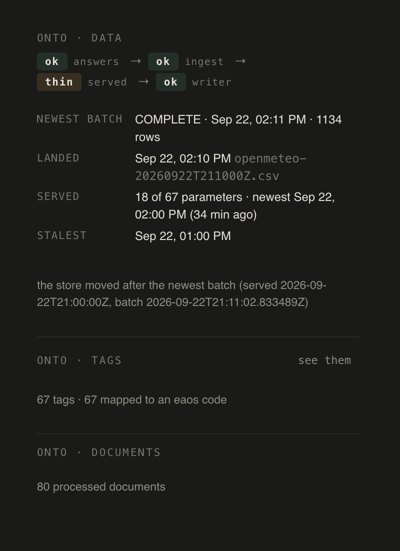
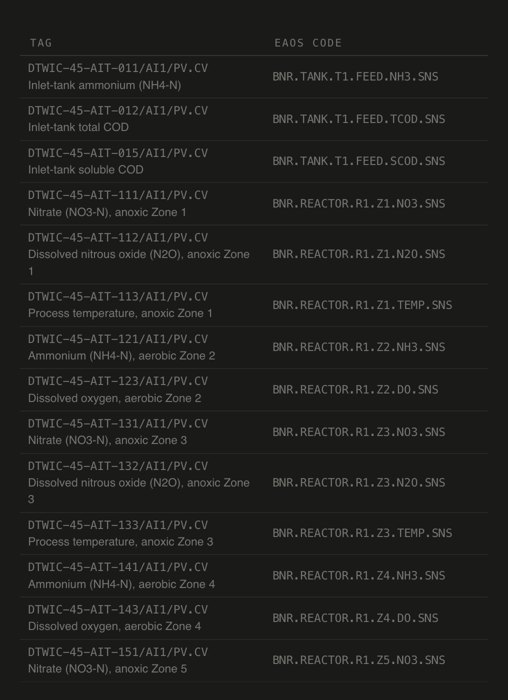
PI, EDS, Seeq and SCADA, and Primodal’s dDOCK at the edge, at their own cadence, with a backfill.
LIMS results and WIMS reporting, by sample point and limit.
The CMMS, its assets and work orders matched to the equipment they name.
SharePoint, drawing sets, O&M manuals and SOPs, cited by sheet and section.
An asset of the utility, and a deliverable of every project.
Places, processes, equipment, signals, documents and records, under one identity that survives renaming, proposed from your P&IDs, asset lists and tag exports. It comes as files you can open anywhere and it outlives the contract. Every project delivers into it and leaves it richer, so a capital study, a permit renewal or the next area starts from it.
The area as tables, with the evidence beside every row.
Every signal on a subject in a place, every document cited by sheet.
What the operators know, reviewed and attached to the equipment.
Every revision, who accepted it, and why.
Whatever the objective needs, running on the record, and yours.
A process model composed from the map, a learned model where the physics is not known, the protocols that run in the background, the reads and the reports. Each is versioned, with an author, a review and a way back. A capability is a configuration on the record, not a system of its own.
Days, not months.
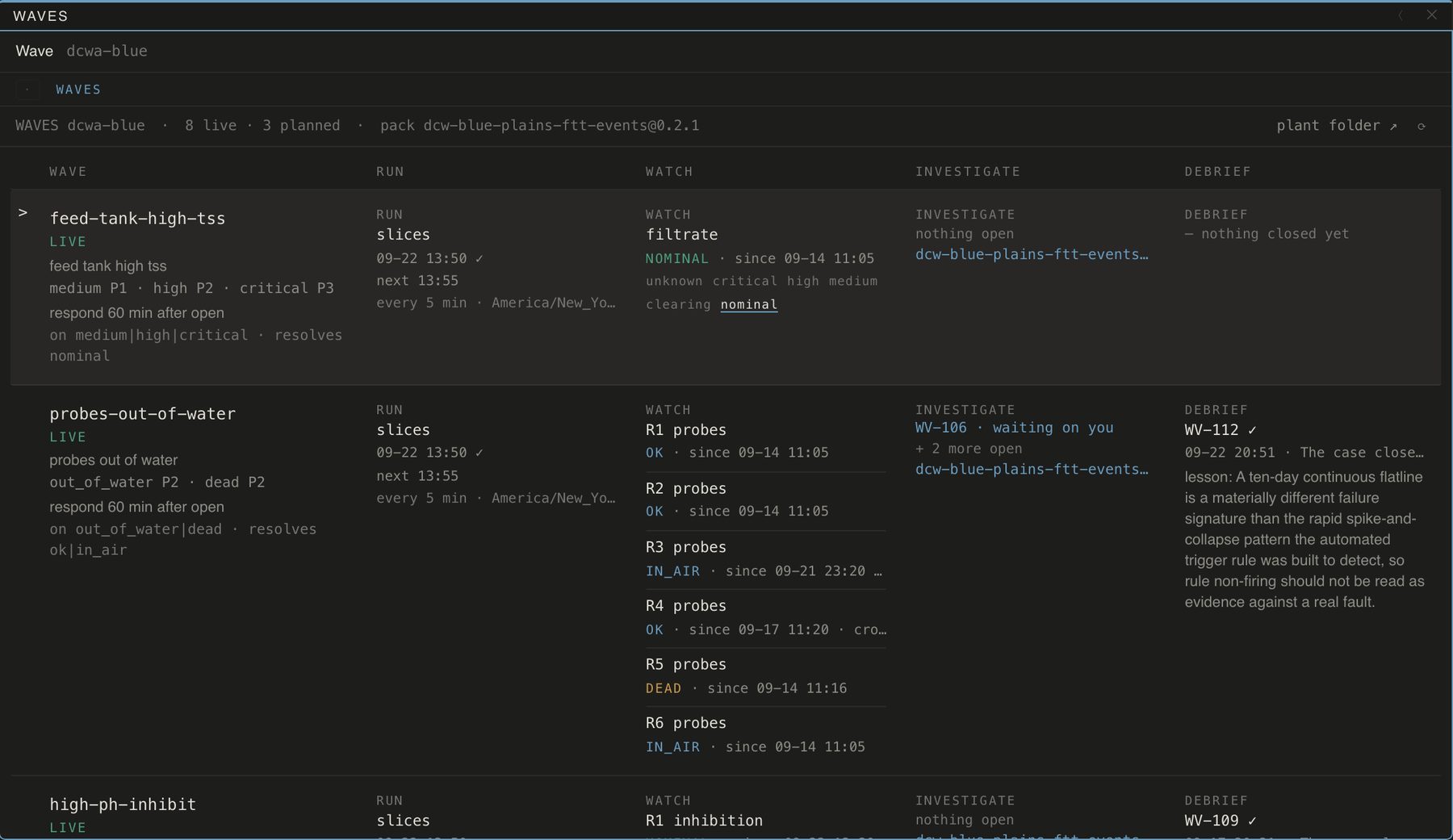
Hosted AI infrastructure under your control.
An agentic system at this scale is a new layer above the historian and beside IT. It needs model providers that change monthly, a distributed runtime, sandboxes, patches, and someone awake when it pages. One team doing that for many utilities costs you less than standing it up for one.
You control it. We keep it running.
You control, and keep if you leave
- The record
- The facility data model, every change on record.
- The analyses
- The models and workflows, and who approved them.
- The work
- Every case, finding, decision and debrief.
- The authority
- What the agent may do in your facility, yours to grant or withdraw.
We host and run
- Your environment
- Yours alone, never mixed with another utility's.
- The connections
- Historian, lab, maintenance, documents, each health-checked.
- The agent
- Eddy, its tools, its workspace, the models it runs.
- The upkeep
- Providers, runtime, evaluation, patches, and the pager.
Everything amplifies.
The second process area is not a second project. The environment exists, the connections are open, and Eddy is already on shift.
The new area's data lands through the door that is already open.
Reads that cross areas become possible, like the whole facility's mass balance.
A protocol written for one chemical serves the next.
The reviewers know the loop. The tenth area is a configuration.
Contracted up front. Run as a service.
No prices here, because every engagement is scoped first. The shape is the same every time.
The environment, the data architecture, the integrations.
up frontThe record and the analyses the area needs. Priced by complexity, never by tag count.
up frontEddy on shift, Soma included, the models served, the infrastructure run.
as a serviceMore areas and more capability, without repeating initiation.
faster than the first